

Thermal analysis at MCL includes thermogravimetric analysis (TGA), differential scanning calorimetry (DSC), and simultaneous differential thermal analysis (SDT), which are thermal analysis techniques used to characterize how materials respond to a controlled temperature program.
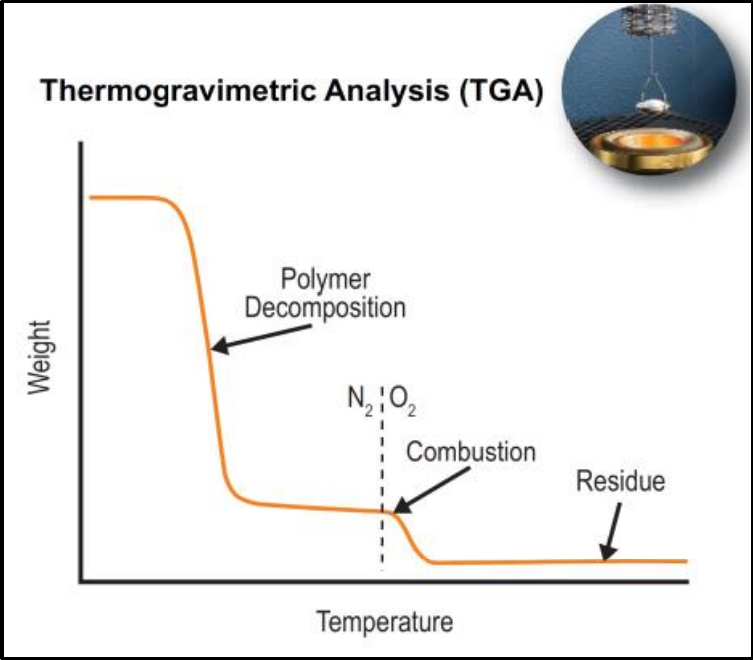
- TGA measures changes in sample mass as a function of temperature or time, providinginformation on thermal stability, decomposition temperatures, oxidation or reductionbehavior, moisture, or solvent content.
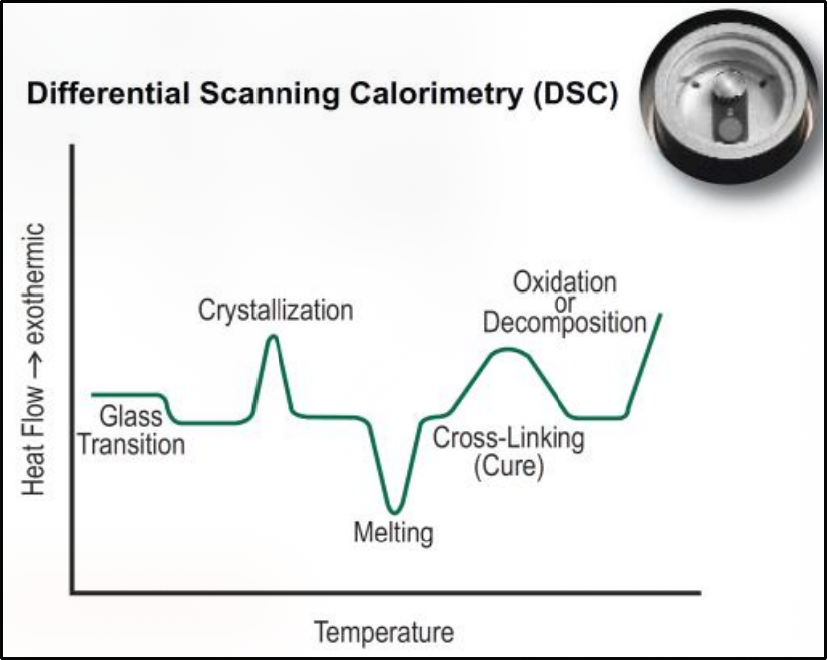
- DSC measures the heat flow associated with thermal transitions in a material, yieldingquantitative information on endothermic and exothermic events such as melting,crystallization, glass transitions, curing reactions, phase changes, and heat capacity.
- SDT instruments combine TGA and DSC (or DTA) measurements in a single experiment onthe same sample, allowing direct correlation between mass changes and thermal events;this is particularly valuable for distinguishing physical transitions from chemically drivenprocesses such as decomposition or oxidation. Together, these techniques offercomplementary insights into composition–structure–property relationships, reactionenergetics, and thermal performance of materials across polymers, catalysts,pharmaceuticals, and inorganic solids.
In addition to standard TGA, hyphenated measurements can be performed using Mass
spectrometry (MS)allowing to characterize the evolved gas during the thermal decomposition.
| Technique | Data Obtained | Applications |
|---|---|---|
| Thermogravimetric Analysis (TGA) | Weight change with temperature. Weight loss/gain in mg and % |
Thermal and oxidative stability of materials from room temperature to 1000 °C under nitrogen or air (other gases can be discussed) |
| Differential Scanning Calorimetry (DSC) |
Heat flow changes with temperature. Heat flow in W/g |
Melting, crystallization and glass transition temperatures from -120 °C to 400 °C under nitrogen. Material decomposition must be below 1wt% over the temperature range of interest. |
| Simultaneous DSC/TGA (SDT) | Combined heat flow and weight loss/gain as a function of temperature. |
Same as TGA and DSC with TGA capabilities from room temperature to 1,500°C and heat flow capabilities from 200 to 1,500°C under nitrogen |
| Thermogravimetric Analysis Coupled Mass Spectrometry (TGA-MS) |
Evolved Gas Analysis: - mass-to-charge ratio (m/z up to 300 amu) of evolved gaseous products. |
Identification of degradation products, residual solvents and contaminants from room temperature to 1000 °C under nitrogen or air. |

MCL Thermal Analysis
The Thermal Lab Suite





The following thermal instruments are available at MCL:
- TGA: Discovery TGA 550 with autoloader (TA Instruments) RT-1,000
- DSC: Discovery DSC 2500 with autoloader (TA Instruments) -120-400°C
- SDT: Discovery SDT 650 with autoloader (TA Instruments) RT-1,450°C
- TGA MS: Discovery TGA 5500 coupled with Discovery MS (TA Instruments) RT-1,000°
| Instrument | Discovery TGA 550 | Discovery TGA-MS | Discovery DSC 2500 | Discovery SDT 650 |
|---|---|---|---|---|
| Technique | Dedicated TGA | TGA and EGA | Dedicated DSC | Simultaneous TGA and DSC |
| Temp. Range (°C) | 25 to 1,000°C | 25 to 1,000°C | -120 to 400°C | 25 to 1,450°C |
| Gas Atmosphere | Nitrogen and air (CO₂ for adsorption) | Nitrogen and air (CO₂ for adsorption) | Nitrogen | Nitrogen |
| Sample Crucible Type | Platinum (Pt pan), Aluminum (Al pan), Alumina (Al₂O₃ pan) | Platinum (Pt pan), Aluminum (Al pan), Alumina (Al₂O₃ pan) | Aluminium (T-zero hermetic and non-hermetic) | Alumina (85) Platinum (85) |
| Typical Sample Size (mg) | 1 to 10mg (up to 100mg for residual solvent) | 1 to 10mg | 1 to 10mg | 1 to 10mg |
| Additional Features |
High resolution TGA (Hi-Res™ TGA) Modulated TGA (MTGA™) |
Hi-Res™ TGA MTGA™ MS: up to 300 amu |
Modulated DSC Capability (MDSC®) |
Hi-Res TGA™ MTGA™ MDSC® |