This can be for any year.

Hexagonal boron nitride crystal growth from iron, a single component flux

Hexagonal boron nitride crystal growth from iron, a single component flux

Project Summary: The highest quality hexagonal boron nitride (hBN) crystals are grown from molten solutions. For hBN crystal growth at atmospheric pressure, typically the solvent is a combination of two metals, one with high boron solubility and the other to promote nitrogen solubility. This study demonstrates that high quality hBN crystals can be grown at ambient pressure using pure iron as a flux which is unexpected given the low solubility of nitrogen in iron.

Electronic changes in molybdenum dichalcogenides on gold surfaces

Electronic changes in molybdenum dichalcogenides on gold surfaces

Project Summary: The electronic properties of transition metal dichalcogenides (TMDs) vary dramatically depending on their phase (2H vs. 1T) and ans the energy to convert between the two phases is predicted to be relatively low. This has sparked interest in the use of the phase change properties of TMDs for active components in electronic devices.

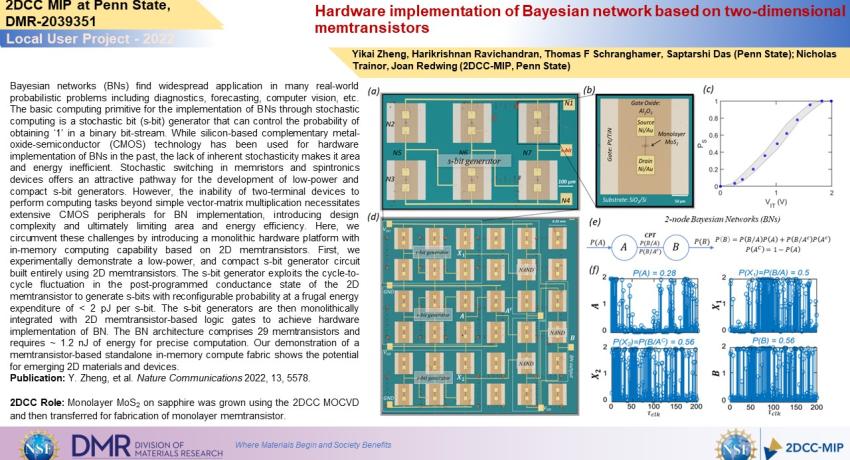
Hardware implementation of Bayesian network based on two-dimensional memtransistors

Hardware implementation of Bayesian network based on two-dimensional memtransistors

Bayesian networks (BNs) find widespread application in many real-world probabilistic problems including diagnostics, forecasting, computer vision, etc. The basic computing primitive for the implementation of BNs through stochastic computing is a stochastic bit (s-bit) generator that can control the probability of obtaining ‘1’ in a binary bit-stream. While silicon-based complementary metal-oxide-semiconductor (CMOS) technology has been used for hardware implementation of BNs in the past, the lack of inherent stochasticity makes it area and energy inefficient.

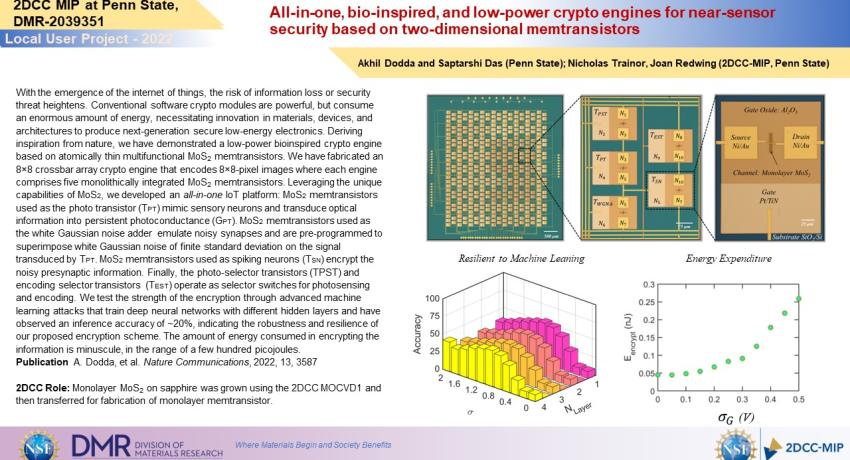
All-in-one, bio-inspired, and low-power crypto engines for near-sensor security based on two-dimensional memtransistors

All-in-one, bio-inspired, and low-power crypto engines for near-sensor security based on two-dimensional memtransistors

With the emergence of the internet of things, the risk of information loss or security threat heightens. Conventional software crypto modules are powerful, but consume an enormous amount of energy, necessitating innovation in materials, devices, and architectures to produce next-generation secure low-energy electronics. Deriving inspiration from nature, we have demonstrated a low-power bioinspired crypto engine based on atomically thin multifunctional MoS2 memtransistors.

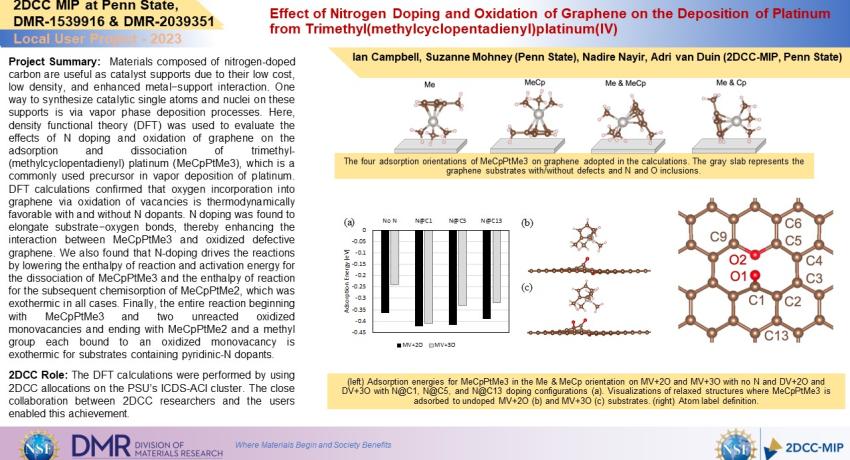
Effect of Nitrogen Doping and Oxidation of Graphene on the Deposition of Platinum from Trimethyl(methylcyclopentadienyl)platinum(IV)

Effect of Nitrogen Doping and Oxidation of Graphene on the Deposition of Platinum from Trimethyl(methylcyclopentadienyl)platinum(IV)

Project Summary:  Materials composed of nitrogen-doped carbon are useful as catalyst supports due to their low cost, low density, and enhanced metal−support interaction. One way to synthesize catalytic single atoms and nuclei on these supports is via vapor phase deposition processes. Here, density functional theory (DFT) was used to evaluate the effects of N doping and oxidation of graphene on the adsorption and dissociation of trimethyl- (methylcyclopentadienyl) platinum (MeCpPtMe3), which is a commonly used precursor in vapor deposition of platinum.